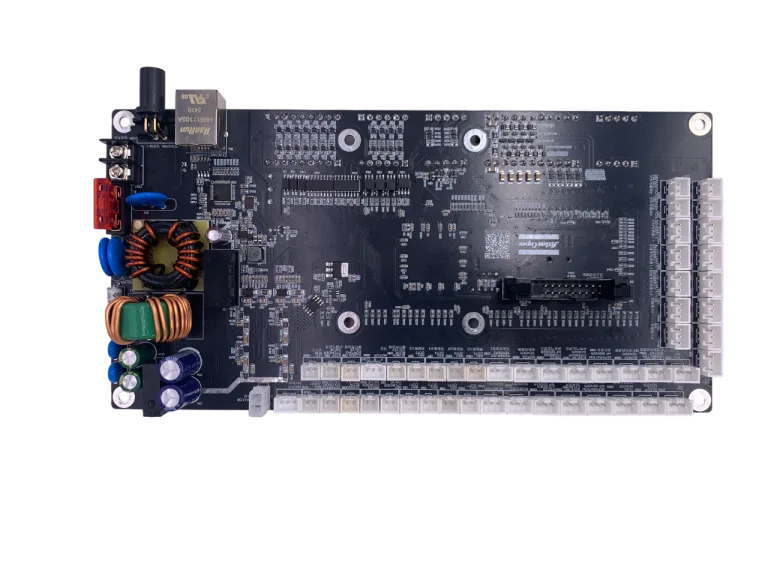

In real-world hardware development, EMC performance is one of the most challenging aspects of PCB engineering. For PCB 4-layer board design, questions such as how to arrange the stack-up, how power/ground planes affect EMC, and how vias and high-speed signals interact all play a decisive role in product stability and certification success.
To help engineers better navigate these challenges, this article provides a structured guide to EMC-aware PCB 4-layer design, covering stack-up strategies, via parasitics, routing rules, and practical considerations for real applications.
1. Preferred Stack-Up Options for PCB 4-Layer Board Design
Common pcb stack-up design solutions include:
Option 1 (Recommended)
Most widely used:
TOP / GND1 / PWR1 / BOTTOM
Option 2
Used when key components are placed on BOTTOM or important signals require bottom-layer routing.
Option 3
For through-hole–dominant boards; PWR on S2, BOTTOM as ground to form a shielding cavity.
2. Key Considerations in PCB 4-Layer Board Stack-Up Design
Signal layer = positive output
Power layer = negative output (copper removal)
Stack-up steps include schematic design, PCB import, preliminary placement, and defining:
- Layer count
- Units
- Pullback for 20H rule
- Naming planes (GND, PWR)
3. Via Design in PCB 4-Layer Boards
Types of Vias
- Through-hole Via
- Blind Via
- Buried Via
By Function
- Signal via
- Power/Ground via
- Thermal via
4. Via Structure and Parasitic Effects
Components
- Drill
- Pad
Common sizes: 0.2mm (drill), 0.4mm (pad).
Parasitic Capacitance
Slows signal rise time; formula:
C = 1.41εTD1/(D2 − D1)
Parasitic Inductance
More harmful in high-speed circuits; reduces decoupling effectiveness.
Formula:
L = 5.08h[ln(4h/d)+1]
5. Via Usage Guidelines
- Use larger vias for power/ground
- Smaller vias for high-speed signals
- Differential pairs must use symmetric via placement
- Multiple vias reduce equivalent inductance
- Microvias recommended for dense 4-layer designs
6. Routing Steps in PCB 4-Layer Board Design
- Start with the most complex area
- Route by functional modules
- Handle remaining low-priority nets
7. Routing Rules for PCB 4-Layer Boards
- Key/high-speed signals get highest priority
- High-density areas first
- Maintain small return loops
- Avoid sensitive signal routing between PWR and GND planes
- Follow impedance-control requirements
Successful PCB 4-layer board design requires not only theoretical knowledge but also extensive engineering experience. Stack-up choices, PCB EMC design, power integrity (PI), parasitic control, and routing strategies all influence product stability, certification success, and mass-production yield.
Tronixv provides end-to-end hardware development services for medical devices, industrial systems, AIoT devices, consumer electronics and more.For engineering support or consultation, feel free to contact us.